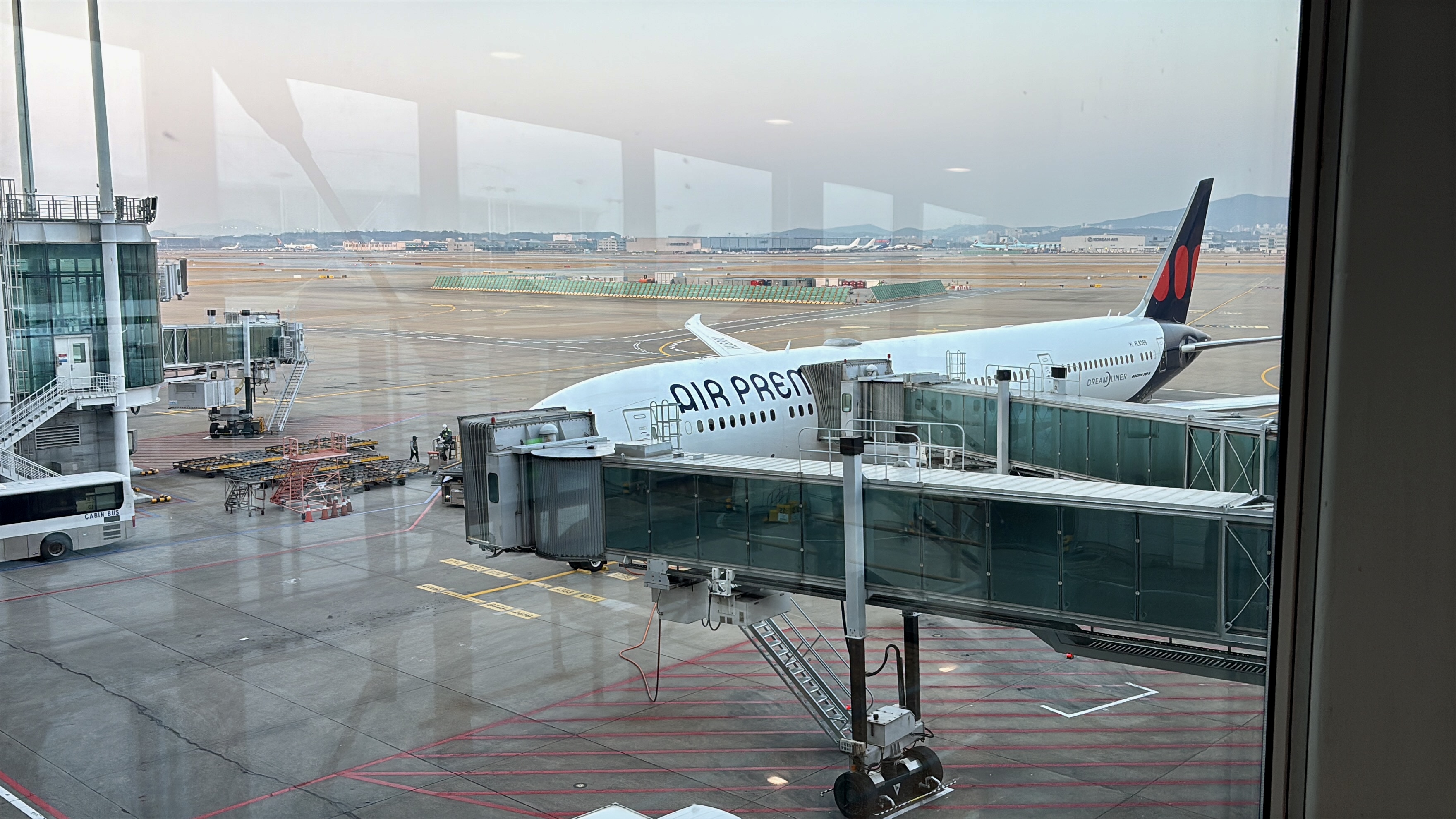
For my recent one-week family trip to Santa Clara, I decided to try Air Premia premium economy (Wide Premium) for both the outbound (ICN–SFO) and return (SFO–ICN) flights. Since Air Premia is still relatively new compared to legacy Korean carriers, I was curious about how it would compare in terms of comfort, service, and overall value.
In this review, I’ll walk through my full experience from check-in to in-flight service, meals, and entertainment. I will also be covering my arrival & departure experience at San Francisco International Airport (SFO), including immigration questions and TSA wait times on the way back.
Location
Santa Clara, San Francisco
Duration of Visit
20 – 28 Mar 2026
Table of Contents
About Air Premia
A Hybrid Airline?
Air Premia is a relatively new Korean airline that positions itself somewhere between a low-cost carrier (LCC) and a full-service airline, marketing itself as a “Hybrid Service Carrier” (HSC). This essentially means that it aims to combine the affordability of low-cost airlines with some of the comfort and service elements of traditional carriers like Korean Air or Asiana. Unlike typical LCCs, Air Premia focuses heavily on long-haul routes such as Seoul to Los Angeles, San Francisco, and other international destinations.
Online Check-in
Air Premia’s online check-in opens 48 hours before departure, and the QR boarding pass was sent 24 hours before the flight. At Incheon Airport, I was able to go straight to the bag drop counter using my QR ticket. They had a separate check-in counter for Wide Premium passengers, so the wait time was shorter than the regular economy line.


ICN to SFO (YP111): In-Flight Experience
Wide Premium Seating & Comfort
Air Premia’s Wide Premium is essentially its version of premium economy, with seats that offer more legroom and a wider seat pitch compared to standard economy. From what I experienced, the extra space made a real difference, especially on a long-haul flight like ICN to SFO.


The Wide Premium seat reclines to about 45 degrees, and there is an adjustable footrest, a bit like a limousine bus seat. It’s not a lie-flat seat so you won’t get a fully horizontal sleeping position like in business class, but it’s still much more comfortable than economy for extended flights.


In-Flight Entertainment
The size and resolution of the personal seat screen was actually quite impressive, and it could also be used to browse duty-free shopping and refreshment options during the flight. However, the content selection was fairly limited. All the options were Korean movies and programs with few recent releases and no international content, which felt a bit unexpected for a long-haul international route. I would recommend downloading movies or shows onto your phone or tablet before boarding.

Welcome Service & Amenities
Shortly after boarding, we were offered welcome drinks and an amenity kit. Inside the pouch, there was a dental kit and several skincare products from Huxley, including hand cream, facial toner, a sheet mask, and cleansing foam.


The pouch itself is quite practical and can easily be reused for future trips. It’s designed to hold up to 1 liter, which helps you intuitively gauge how much liquid you’re bringing on the plane.
Meals & Drinks
First Meal: Bibimbap
The first meal was served shortly after takeoff, with a choice between bibimbap and fried chicken with rice. I chose the bibimbap, which came with rice topped with colorful vegetables and ground beef. On the side, there was a cranberry chicken and tomato salad, bread with butter, and a small cheesecake for dessert. They also offered complimentary drinks, and I had a glass of Terra Pura Chardonnay🥂


Overall, the meal was satisfying and well-balanced. The portion size felt slightly smaller than a full-service Korean airline. Personally I preferred this because eating too much on a plane always makes me feel bloated.
Second Meal: Omelette & Rice Porridge
For the second meal (breakfast), we could choose between an omelette and rice porridge. I went with the omelette, which came with broccoli, potato wedges, and a sausage. It was served with mustard coleslaw with ham and a side of fruit.


My mom chose the porridge, which came with the same side dishes. Both options felt light and appropriate for a pre-landing meal☕
Arrival at SFO: Immigration Experience
I was a bit nervous about the immigration process at San Francisco, but the actual experience was much smoother than I’d expected.
SFO Immigration Questions
When I approached the officer with my mom, she asked a few standard questions:
- Why I was visiting
- How long I would stay
- Whether I was visiting family
- How much cash I had
- Whether I was bringing any food
- My hotel address (The officer asked for the full address, so I had to look it up on Google Maps and show it on my phone.)
I also had a printed copy of my ESTA application just in case, but it wasn’t requested.
ICN to SFO (YP112): Return Flight Experience

How Early Should You Arrive at SFO?
For my return flight (YP112) scheduled at 3:30pm, I was concerned about long TSA lines after hearing about delays at major US airports. However SFO turned out to be much more efficient than expected. I arrived about 2 hours before departure, which was more than enough.


Since I didn’t have checked baggage, I was able to go straight to security. There was virtually no line at the Air Premia counter (Aisle 4), so I don’t think the wait time would be much longer even if you do have bags to drop . The TSA security check only took about 5 to 10 minutes, and the entire process from entering the airport to reaching the airside area took around 30 minutes.
Return Flight Experience
The return flight from San Francisco to Seoul is 3 hours longer, taking around 13 hours. The seating and entertainment were identical to the outbound flight.
First Meal: Baked Fish
The first meal was served about 40 minutes after takeoff. This time, the options were beef bibimbap or baked fish with potatoes and I chose the fish. The dish included baked cod topped with a creamy sauce, along with potato wedges and steamed vegetables. It was served with bread and butter, corn salad, and a blueberry cheesecake. I appreciated the seafood option, as it offered some variety compared to the outbound flight. The flavors were well-balanced, and overall it was a satisfying meal.


Snack
Midway through the flight, we were given a dorayaki (sweet red bean pancake) as a snack. This was a nice touch, especially on a longer flight where things start to feel boring without anything to eat😂

Second Meal: Shrimp Tomato Pasta
The second meal was served about two hours before landing, with a choice between fried rice and shrimp tomato pasta. I chose the pasta, which was topped with shrimp, cheese, and steamed vegetables. On the side there was a potato & smoked salmon salad, along with fruits. The pasta overall felt a bit bland so I wished there had been more sauce and cheese to enhance the flavor.


Overall
After experiencing both legs of the journey, I would describe Air Premia’s Wide Premium as a solid, practical option for long-haul travel. Its biggest strengths are the spacious seating, well-executed meals, and efficient check-in process.
There are a few trade-offs to keep in mind like the limited in-flight entertainment and lack of lounge access, but this seems to be consistent with Air Premia’s hybrid positioning. If you value comfort and space but don’t want to pay the premium of legacy airlines, Air Premia is definitely worth considering.


Leave a Reply